Cleveland Clinic Hosts 2nd Annual Discovery & Innovation Forum
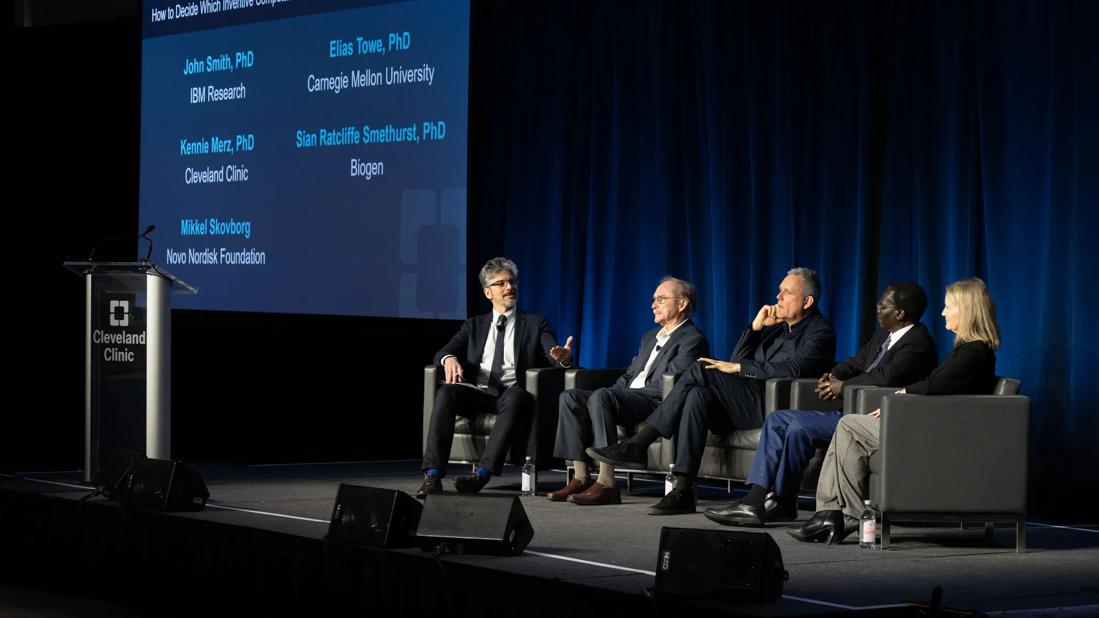
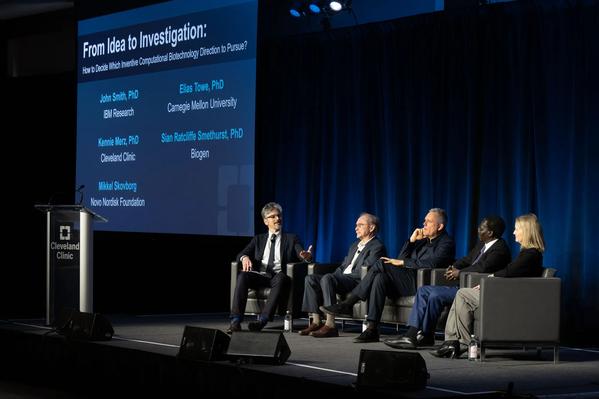
Panelists discuss computational biotechnology as part of the Cleveland Discovery & Innovation Forum. From left: moderator, Dr. John Smith, IBM Research; Dr. Kenneth Merz, Cleveland Clinic; Mikkel Skovborg, Novo Nordisk Foundation; Dr. Elias Towe, Carnegie Mellon University; Dr. Sian Ratcliffe Smethurst, Biogen.
Cleveland Clinic’s second annual Cleveland Discovery & Innovation Forum brought together international leaders to discuss advancements enabled by quantum computing, artificial intelligence and digital health. The forum highlighted how these new technologies are transforming the future of medicine and patient care.
This year’s event, designed in collaboration with the National Science Foundation, hosted more than 20 speakers from academia, industry, foundations, venture capital and government to explore the current landscape and potential future of healthcare and life sciences research. Additionally, several new research announcements were made at the event that was held on April 7 at Cleveland Clinic’s main campus.
“We need the best minds in medicine and technology to work together to solve healthcare’s toughest challenges,” says Lara Jehi, M.D., Chief Research Information Officer at Cleveland Clinic. “We created the Cleveland Discovery & Innovation Forum to bring together global leaders in research and innovation to explore how advanced computing can drive new discoveries and help improve healthcare for all patients.”
Cleveland Clinic leaders moderated panels and fireside chats. Highlighted sessions included:
Fireside Chat: Alessandro Curioni, Ph.D, IBM, Serpil Erzurum, M.D., Cleveland Clinic
Panel: Funding Advanced Computation in Biomedical Science – featuring U.S. Representatives Shontel Brown and Max Miller
Panel: Prioritizing Computational Biotechnologies for Real-World Impact
Fireside Chat: Innovations Taking Discoveries to the Next Level – David Cox, Ph.D., IBM, Rohit Chandra, Ph.D., Cleveland Clinic
This year, the forum was officially recognized as part of the International Year of Quantum Science and Technology, led by UNESCO. Cleveland Clinic announced plans, in collaboration with UNESCO, to provide researchers in Africa with remote access to IBM Quantum System One located at Cleveland Clinic’s main campus. This initiative will allow researchers to use advanced computing technologies that were not accessible before. “Through this collaboration, we will work together to advance the development of basic sciences, engineering and STEM education,” says Amal Kasry, Ph.D., Chief of Basic Sciences, Research Innovation, and Engineering Section at UNESCO. “This agreement not only emphasizes the need to drive innovation in quantum technologies, but also highlights the importance of ensuring access to these technologies for all.”
Other new partnerships and updates were shared during the event and highlighted Cleveland Clinic’s steadfast progress in building the Ohio Discovery Corridor through its Cleveland Innovation District. These included:
- A collaboration between Columbus-based CAS and Cleveland Clinic to advance research on healthy aging and prevention of chronic diseases, including Alzheimer’s. CAS is a division of the American Chemical Society that provides data and information management for healthcare and life sciences research.
- Updates on this year’s Cleveland Clinic Quantum Catalyzer Program, which provides quantum access to start-up companies. This year, the K5 Toyko Black Fund will provide $1 million with an in-kind match from Cleveland Clinic to the winning start-ups.
- Details on an innovative partnership between Miami University and Cleveland Clinic that will provide advanced education in quantum computing to students.
- Cleveland Clinic is joining the Global Industry Challenge, organized by Connected DMV and the Quantum World Congress to celebrate the International Year of Quantum. The Life Sciences Challenge aims to develop innovative techniques using Noisy Intermediate-Scale Quantum (NISQ) devices or hybrid-classical approaches to analyze a neural network dataset. The challenge aims to use these quantum computing techniques to improve understanding of brain activity and aid in developing effective treatments for neurological disorders.
The Cleveland Discovery & Innovation Forum also highlighted cutting-edge research supported by Cleveland Clinic’s 10-year Discovery Accelerator partnership with IBM, which is focused on advancing the pace of biomedical research through the use of high-performance computing, AI and quantum computing.
link