Farewell, SaaS: AI Is The Future Of Enterprise Software – New Technology

The enterprise software industry serves as a poster child for
change and innovation. Just a few decades ago, enterprise software
solutions had to be installed manually on computers via CD-ROM
drives. Then the jump to modern, Software as a service (SaaS)
offerings, installed and updated remotely via the cloud,
revolutionized both operations and licensee business
models—but companies cannot get comfortable. And the next
evolutionary segment of enterprise software is already here.
Generative artificial intelligence (GenAI) and AI agents are
driving the industry’s next major revolution. These innovative
technologies have arrived at a time when midsize enterprise software companies are caught
in a big squeeze, pressured on one side by AI-native
players’ driving innovation at lower costs and on the other by
big tech companies’ pouring billions into the AI arms race. By
undergoing their own AI transformation—from selling software
to selling AI-powered services—enterprise software companies
can boost both their revenues and their valuation multiples.
With that said, the rapid pace of AI adoption raises major
hurdles. Like the shift from perpetual licenses to SaaS, the
launching of new products is only part of the picture. A successful
transition requires a brand-new business model and thoughtful
implementation across product road map, pricing, sales, and
operations. Without careful planning, transition to GenAI and AI
agents could just as easily disrupt revenues as it could enhance
them.
Enterprise software companies must ensure that integrating AI
into their products creates a lasting competitive advantage rather
than a short-lived gain—or even a decline in value.
Perpetual-to-SaaS is the past. SaaS-to-AI is the future
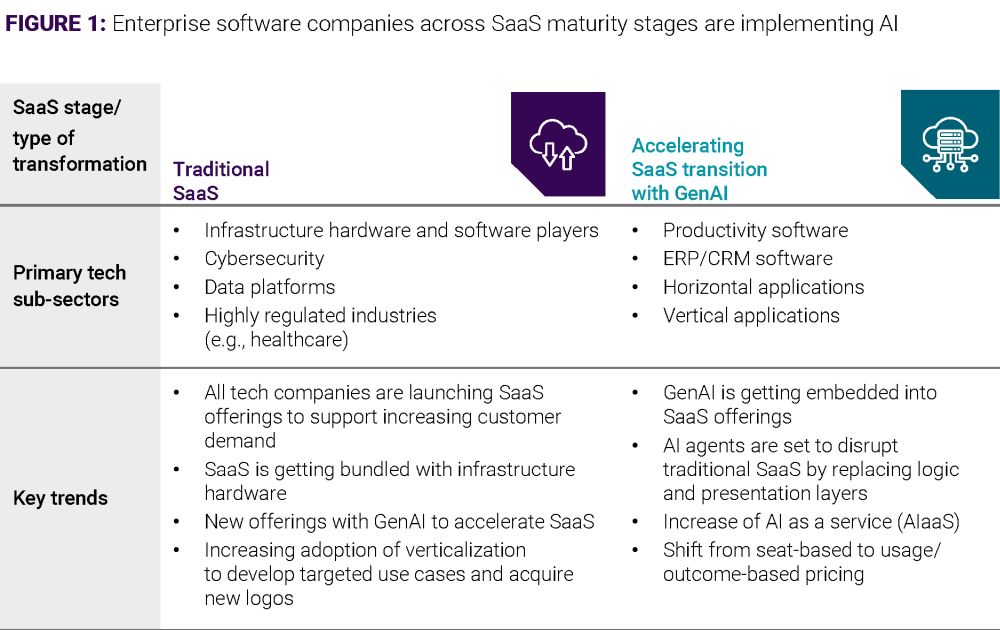
While industries with mature SaaS products such as productivity
software, enterprise resource planning (ERP) systems, and customer
relationship management (CRM) systems are quickly adopting GenAI
and AI agents, early-stage companies in highly regulated industries
such as healthcare, too, are starting to incorporate AI into their
offerings.
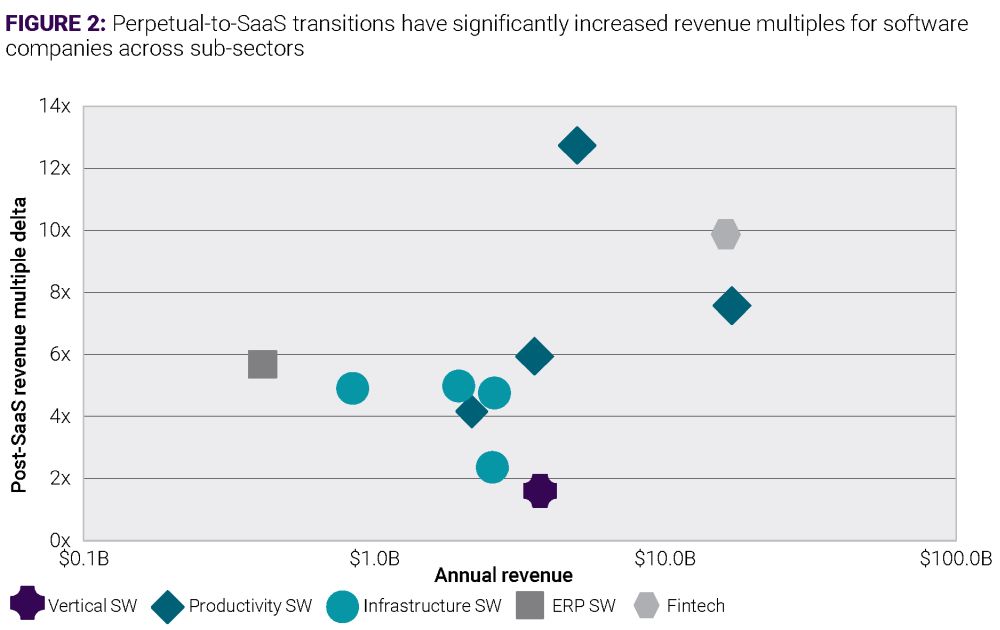
We studied the journeys of several companies that transitioned
from a perpetual to a SaaS model across multiple enterprise
software industry subsectors. Our analysis found that the change
drove a 4-6x increase in revenue multiples—and we believe
that companies that successfully transition to GenAI and AI agents
and make matching business model shifts will see additional jumps
in their revenue multiples. This helps explain why, according to
the 2025 AlixPartners Disruption Index, nearly 90% of software
executives are optimistic about the impact of AI on their
respective businesses.
AI agents: The new entrants in AI-driven transformation
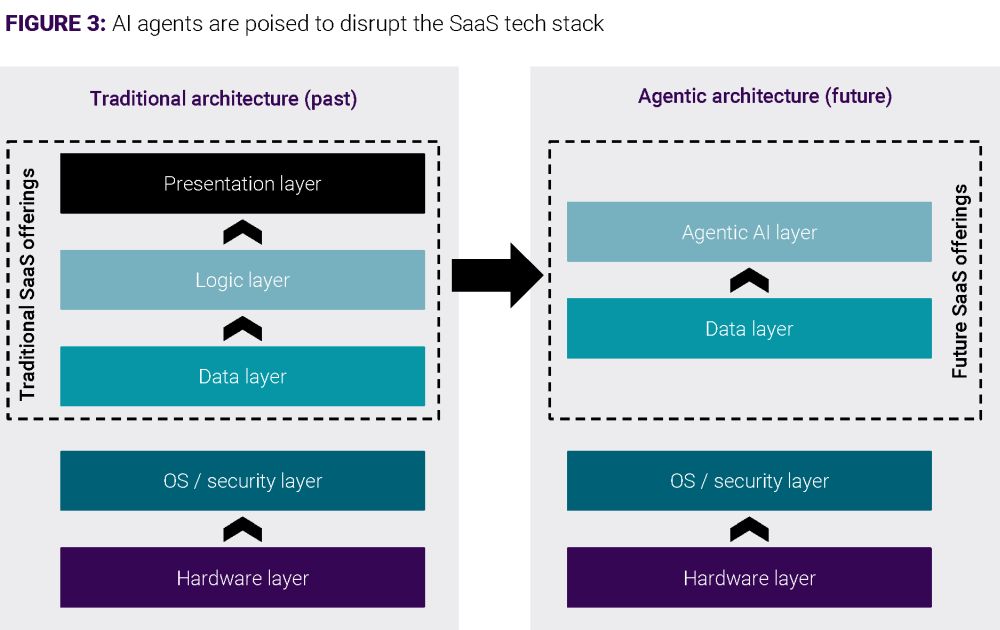
When we mention AI agents, we are referring to AI systems that
can independently set goals, make decisions, and take actions. AI
agents fundamentally alter the traditional SaaS tech stack by
replacing the logic and presentation layers that SaaS players rely
on with an agentic AI layer, thereby transforming how businesses
operate.
AI-native players are already starting to enact this model, and
SaaS incumbents must follow suit by launching AI agents of their
own to stay competitive. The shift can facilitate more autonomous,
more personalized, and more scalable operations, significantly
reducing costs while unlocking new revenue streams.
Earlier this year, HubSpot introduced Breeze, a suite of agentic
AI tools designed to enhance small-business operations.
Breeze’s knowledge base agent, for instance, identifies and
closes knowledge gaps in customer support data, thereby
streamlining customer response and sales lead outreach. ServiceNow
is growing its AI agent capabilities through its recent acquisition
of Moveworks, a company specializing in AI assistants that
integrate into enterprise systems, including HR, IT, and
finance.
Activating impact: How AI creates value
GenAI solutions, including AI agents, are transforming the ways
enterprise software companies deliver value to customers and
investors. Customers now expect AI-driven solutions that enhance
the user experience and product functionality.
We recently worked with a software-based cloud infrastructure
company to launch a SaaS platform with embedded GenAI capabilities.
To drive customer adoption, we helped the client identify key use
cases and created a tiered monetization system for the GenAI
offering. We also established a transformation management office to
facilitate the migration of existing customers to the new AI/SaaS
platform. Those steps, combined with refined sales and marketing
motions, led to a successful launch.
Enterprise software companies need to focus on three
value-creation levers when integrating AI:
Thoughtful GenAI and AI agent product
roadmap
AI products are emerging as key drivers of topline growth. By
incorporating GenAI into their product roadmaps, businesses can
develop innovative solutions that meet complex customer challenges.
Such AI-driven products provide customers with personalized,
data-driven insights, automated content generation capabilities,
and advanced decision-making tools, among other solutions. As the
products evolve, they will not only meet current customer needs but
also open new revenue streams, positioning enterprise software
companies at the forefront of AI-driven transformation.
Salesforce, for example, has closed 5,000
deals for its Agentforce AI platform since October 2024, including
more than 3,000 paid customers.
Revenue models to monetize GenAI
AI integration can unlock new revenue models—such as
usage-based and outcome-based pricing—that offer greater
flexibility and align more closely with the value customers
receive, enabling businesses to adapt pricing based on
customers’ needs and usage patterns. Moreover, incorporating AI
agents into product roadmaps can improve product adoption and
present new opportunities to monetize.
ServiceNow is one company that has implemented both usage-based
and outcome-based pricing to alter its revenue models. It lets
customers pay per automated incident resolution or per AI-driven
workflow while also tying pricing into reduced ticket resolution
times and lower labor costs. Sierra, too, offers outcome-based
pricing for its AI agents, stating, “we’re only paid when
we drive real results.”
Streamlined business operations
Integrating AI within a software company’s core operations
can also drive value. AI capabilities can expedite product
development, boost customer engagement, and streamline workflows.
For example, AI agents can handle and process data more
efficiently, which leads to better decision-making and customer
insights. By automating repetitive and time-consuming business
processes, AI frees team members to focus on more strategic
tasks.
According to Klarna, the company’s AI assistant, powered by
OpenAI, is already doing the job of 700 workers. The
assistant managed 2.3 million conversations within a month of its
launch, matching human agents in customer satisfaction. Klarna says
the result contributed to an estimated $40 million profit
improvement for the company in 2024.
Four key challenges to GenAI and AI agent implementation
Companies undertaking the SaaS-to-AI journey face several
challenges that must be met if the companies are to deliver value
for customers and investors.
The challenges include:
1. Competition from AI-native players
AI-native competitors, operating with leaner business models,
can offer superior solutions at lower prices, making it difficult
for traditional SaaS companies to maintain their margins. The pace
of AI advancement enables the AI-native competitors to quickly
replicate and enhance AI features, which can lead to intense price
competition, further squeeze margins, and increase the pressure on
incumbents to innovate and adapt.
2. Increased costs
SaaS companies pivoting to GenAI or AI agent offerings face
elevated compute costs because GenAI incurs higher expenses by
adding token fees on top of standard hosting and support costs. The
move to agentic AI also increases support costs because the need
for higher-level engineers for complex AI debugging replaces
less-expensive service agents. To maintain their current operating
incomes, companies will have to reduce costs and increase
efficiency elsewhere in their businesses (e.g., back-office
operations, organizational redesign, and third-party vendor spend)
to offset AI-related cost increases and fund the transition
journey.
3. Revenue unpredictability
The shift from seat-based pricing, with fixed revenue streams,
to outcome-based pricing can increase unpredictability. Because
revenue is now tied to customer outcomes, any fluctuation in those
outcomes could lead to variations in financial performance. In
addition, revenue now depends on multiple factors outside the
company’s control, such as customer data accuracy and the
effectiveness of a given AI solution.
4. Operational disruptions
Companies often have to overhaul their processes and redesign
workflows to ensure AI tools get embedded seamlessly into
day-to-day activities. Such an overhaul generally requires
extensive employee training. Additionally, companies must upgrade
their infrastructures so as to construct the right technological
foundation that will support AI capabilities. This can cause
operational disruptions alongside cost increases if the
transformation isn’t executed correctly.
The enterprise software industry’s new
frontier
AI is neither just a new product in the SaaS portfolio nor an
add-on to existing services; it is the industry’s next
evolution, and it requires fundamental business model changes. If
implemented strategically, GenAI products and AI agents will propel
the next significant leap in valuation multiples. Enterprise
software companies that embrace that evolution by taking thoughtful
approaches will position themselves to leap ahead of the
competition.
The content of this article is intended to provide a general
guide to the subject matter. Specialist advice should be sought
about your specific circumstances.
link